From campus to clinic: ESa simulation center design prepares future clinicians
Ben Metz, AIA, NCARB, LEED® AP
The Belmont University Center for Interprofessional Engagement and Simulation represents a new era of healthcare education that is defined by immersive technology, interdisciplinary learning and design that mirrors the real world of care.
As healthcare demands grow more complex and clinical training opportunities become harder to secure, simulation has become an essential bridge between readiness and risk-free practice.
Located in the Thomas F. Frist, Jr. College of Medicine at Belmont University building, the simulation center operates independently, reports directly to the provost and serves 10 disciplines, including graduate and undergraduate nursing, PT/OT, pharmacy, social work, mental health counseling and medical students. For ESa, the center reflects the convergence of two core strengths: higher-education environments that support learning and healthcare spaces that mirror clinical reality.
By providing realistic, well-designed training environments, the center helps academic programs meet the expectations of modern clinical practice even when real-world training opportunities are limited. Architects played a key role in shaping not only how the space looks, but how it functions for students and future clinicians.
“Simulation centers are where learning and doing meet – and design has to support both,” said Ben Metz, ESa principal.
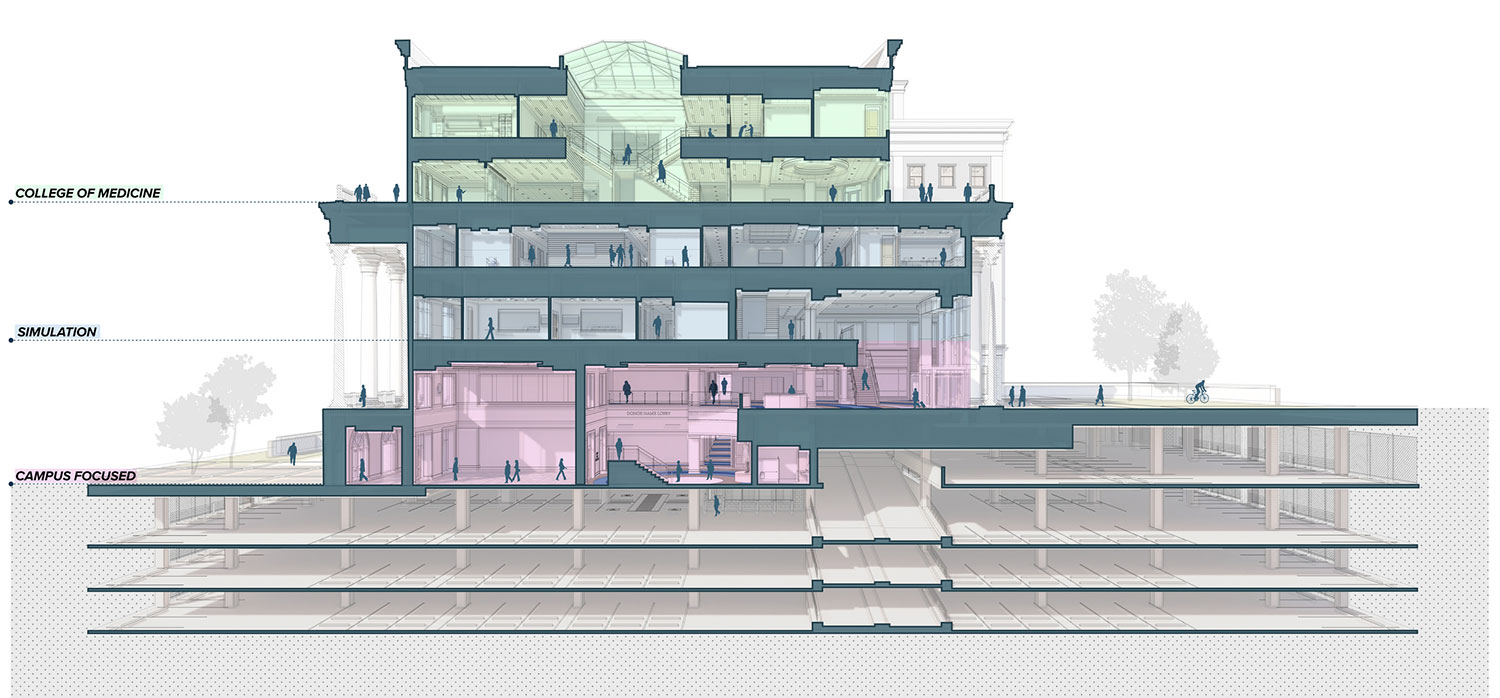
Designing spaces that teach like hospitals work
Simulation centers are the bridge between classroom learning and clinical reality. They allow students to practice decision-making and patient care in a controlled yet realistic environment. ESa applies lessons from healthcare and education to design centers built around flow, technology and flexibility.
The layout of the center connects inpatient pharmacy, patient rooms and anatomy labs in close proximity, encouraging movement and interaction similar to a hospital environment.
“Being in a shared space lets us collaborate with other disciplines more naturally,” said Beth Hallmark, director of Education in the Center for Interprofessional Engagement and Simulation. “It’s changed how we design scenarios and how students learn from each other.”
Technology’s role in modern medical training
Technology integration is essential to modern healthcare education. It underpins every simulation and assessment students experience.
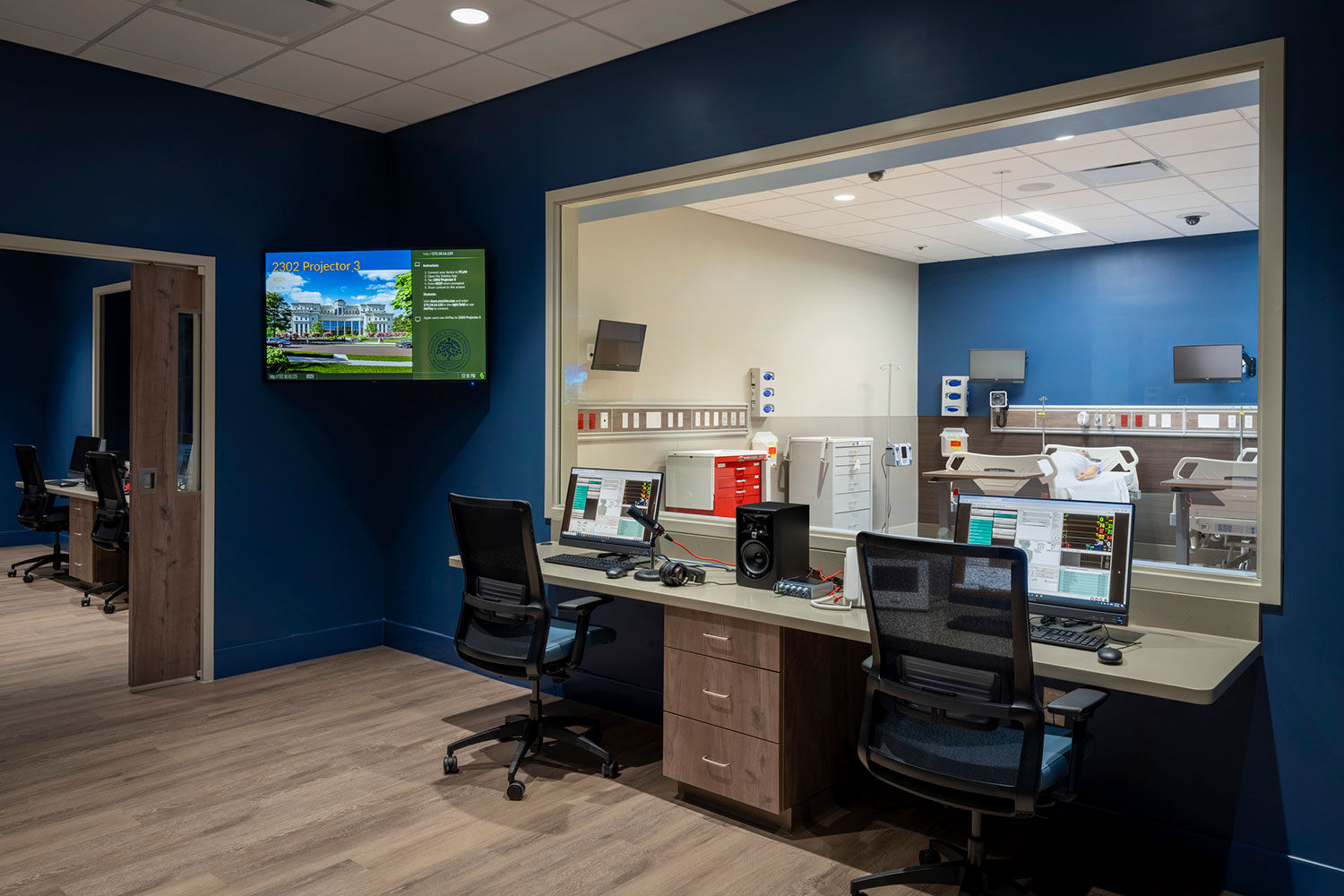
ESa collaborated with Belmont’s IT department and specialized AV consultants to design an infrastructure capable of supporting high-fidelity simulations and digital testing. Strategic camera placement for every learner and high-quality video for students to observe and watch back simulations were integral to the center’s design. This allows students to analyze their decisions in real time, understand the impact of their actions and refine their clinical judgment with each scenario.
“Technology can make or break these projects,” said Ben. “We spent a lot of time with a small, dedicated task force, coordinating AV systems to confirm they were seamless and future-proof.”
Simulation in practice
While the center is only a year old, Belmont is rapidly expanding interprofessional simulations structured to mirror how clinicians collaborate and develop competence over time. The Center is divided across two floors to support different stages of progression:
- Skills training level: Faculty-led instruction where students learn procedures and technical skills.
- Assessment level: Independent simulations where students apply their knowledge while being observed.
The spatial separation guides students from guided learning to independent practice and ensures they experience the full arc of simulation education. Visibility, privacy and spatial flow are carefully planned to create a realistic, secure testing atmosphere.
“In kindergarten, you put up a box so you couldn’t peek at your neighbor’s test,” said Ben. “Here, that box is integrated into the technology and architecture.”
Recent scenarios include senior nursing students in an end-of-life simulation, allowing learners to understand the clinical decision-making and communication required when a patient’s status changes. PT and OT students are running interprofessional mobility scenarios where they learn to jointly navigate and respond when a patient declines or crashes during a routine transfer.
Other simulations challenge multidisciplinary teams with real-world scenarios, from caring for non-English-speaking patients using interpreters to managing crises collaboratively, while law students observe to understand the legal considerations in acute-care settings.
“The biggest benefits of simulation come when students apply what they learned and reflect on that experience,” said Beth. “This space supports every part of the learning process.”
These scenarios reflect how healthcare systems work in reality. Design makes them possible.
A community asset, not just a campus resource
The simulation center is not just helping Belmont students train. Multiple schools have already taken advantage of its state-of-the-art design, reinforcing the building’s purpose as an interdisciplinary, regional hub designed for collaboration.
Trevecca University’s PA program uses the center, and patient actors were trained to work at HCA’s graduate medical programs. Statewide organizations like the Tennessee Simulation Alliance and SimGHOSTS have also hosted conferences in the center, expanding its impact beyond Belmont.
“We are a community asset, training healthcare providers and enhancing care for patients across the state,” said Beth.
Why institutions trust ESa for innovation
Simulation centers are one way ESa’s healthcare and higher-education expertise come together to shape environments that foster learning and clinical practice. Technology supports the experience, but the integration of academic needs and clinical workflows drives the design.
ESa’s approach is unique because:
- We listen, then act. From room layouts to equipment placement, the team translated faculty and student needs into design decisions. In this project, which included physically taping out room dimensions in the old simulation lab to confirm that proportions, outlet locations and medical gas points aligned with real clinical environments.
- We hire people with lived clinical experience. ESa’s education and healthcare teams include professionals who have practiced in the field, ensuring the design reflects the workflow, safety considerations and daily realities of end users.
- We have professionals across sectors under one roof. Architects, interior designers and other professionals worked together from the beginning to support both how students were taught and how real healthcare environments function, without sacrificing one for the other.
- We immerse ourselves in the field. During this project, Ben attended a major national simulation conference with the design team to better understand emerging standards, technology and the day-to-day challenges of simulation educators. This helped the team design rooms, AV infrastructure and observation spaces that align with best practices and the expectations of accrediting bodies.
ESa’s work at Belmont shows how design helps technology serve its purpose, so students practice medicine safely and confidently before they ever enter a hospital work environment.
“This building changed how our students learn,” said Hallmark. “The realism, the flow, the technology – it all works together because ESa took the time to understand what actually makes a simulation effective. Our students walk in better prepared for clinical practice because the environment was designed with such intention.”
Considering how your campus can better train future clinicians? Contact ESa to discuss your options.