The emergency department isn’t too small. It’s full of patients who belong upstairs in inpatient beds.
Andrew Collignon, AIA, JD, NREMT
How ESa helped a large academic medical center in Georgia identify the cause of adult emergency department crowding and diversion — and why the recommended solution is on the inpatient floors.
The question we were asked
The academic medical center’s adult ED regularly feels full. Hallway beds are in use, patients wait in the lobby and, on some days, the department goes on diversion and turns ambulances away. The natural question is whether the 88-bed adult ED needs to grow.
We were engaged to answer that question with data. We analyzed a full year of activity from July 2025 through June 2026 — covering 48,633 adult ED visits, and reconstructed how the department’s beds are used, hour by hour. The findings changed the question. The adult ED has enough beds for the emergency care it delivers. What it lacks is somewhere to send patients it has decided to admit. That problem is boarding.
What boarding is, and why it matters
Every adult ED visit has two phases. First, the patient is examined, tested and treated until a clinician decides whether the patient can go home or needs to be admitted. Patients going home leave within minutes. Patients being admitted need an inpatient bed. When none are available, they stay in an ED room — still occupying space and requiring nursing care — until a bed becomes available upstairs.
Those patients are boarders. Their emergency care is finished, but they are operationally inpatients housed in emergency department space. Every hour a boarder spends in an ED room is an hour that room can’t serve the next patient arriving by ambulance or walking in from the waiting room.
What we found
About 29% of adult ED patients are admitted or placed in observation. Our analysis shows those patients wait an average of about 13 hours between the admission decision and leaving the ED, compared with about 25 minutes for patients who go home. Across all patients, a visit occupies an adult ED room for about 525 minutes — nearly nine hours. Only about 279 minutes are spent on treatment. The rest is waiting.
When we reconstruct the department’s occupancy across the full year, the pattern is clear:
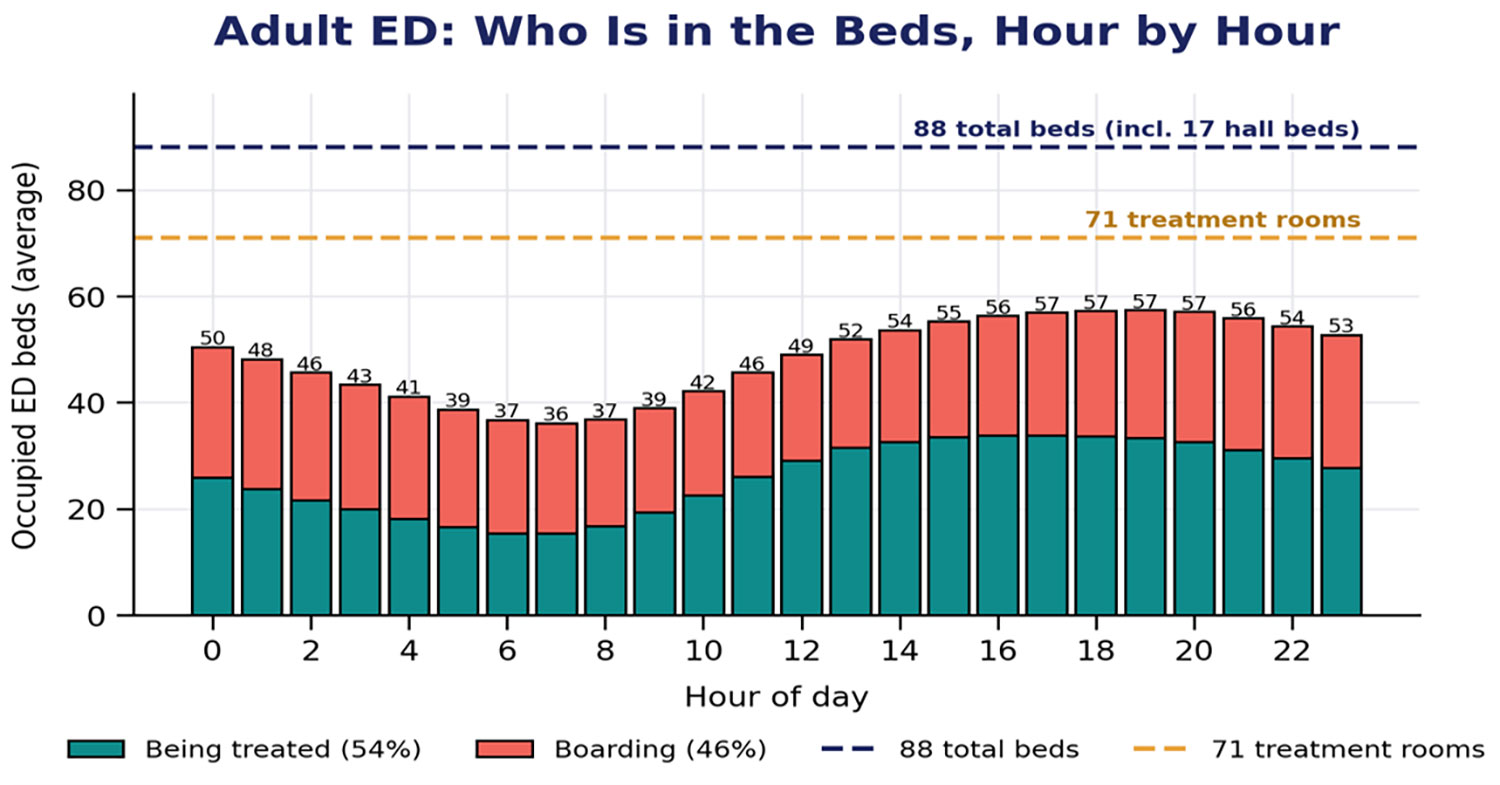
Average occupied adult ED beds by hour. Teal represents patients receiving treatment; coral represents admitted patients waiting for an inpatient bed. Dashed lines mark the adult ED’s 88 total beds and 71 treatment rooms (88 minus 17 hallway beds).
- 46% to 47% of all occupied ED bed-hours belong to boarders. Nearly half the department functions as an unofficial inpatient unit.
- At the evening peak, about 57 beds are occupied on average — roughly 34 patients receiving active treatment and 23 boarding.
- The boarding load never clears. Even during the quietest morning hour, 18 or more ED beds hold admitted patients, so each day begins with part of the department already occupied.
Nearly half of the adult ED’s occupied beds hold patients whose emergency care is complete.
Solving the 88-bed paradox
Our first step is to size the adult ED for its clinical workload alone. Two independent methods — a percentile-of-census approach and a queuing model — both point to roughly 65 to 78 treatment spaces. On paper, 88 beds should be enough. So why does the department go on diversion?
A simulation of the department answers that question. If all 88 beds were fully interchangeable and staffed, the simulated ED would almost never go on diversion. Real beds, however, aren’t interchangeable: 17 of the 88 are hallway beds — spaces that lack the privacy, equipment and isolation capabilities of a treatment room. Without them, the department has just 71 rooms, already at the edge of the range where diversion begins. When we also account for rooms occupied by boarders, isolation requirements, staffing limits and rooms reserved for specific patient types, the usable pool falls to about 70 to 80 beds — the range where diversion begins. With 80 usable beds, diversion occurs about 0.2% of the year; with 70, it occurs about 2%.
That is the key finding we brought to the client: The adult ED isn’t too small for its emergency work. Boarding takes away the space it needs to do that work.
Translating boarding into inpatient beds
To explain the problem clearly, we express boarding in inpatient terms. Adult ED admissions spend about 184,000 hours a year boarding. Spread across the 8,760 hours in a year, that equals about 21.6 inpatient beds occupied around the clock. Because inpatient units can’t operate at 100% occupancy, we apply an 85% target occupancy rate, which comes to roughly 25 staffed inpatient beds — about one full medical-surgical unit. Based on billing patterns, about one in five of those beds would be at intensive care unit or intermediate care intensity.
Put simply, a medical-surgical unit’s worth of patients is living in the emergency department every day.
The solution we recommend
Rather than expanding the adult ED, we recommend adding inpatient capacity to address the problem at its source. When a bed opens upstairs sooner, the boarder moves sooner and the ED room returns to its intended purpose. The first additional beds have the greatest impact.
The inpatient beds serving ED admissions are nearly full. At that level of utilization, a small amount of added capacity sharply reduces waiting — much like one additional checkout lane at a busy store can shorten the line. We modeled that relationship using the client’s actual admission volumes:
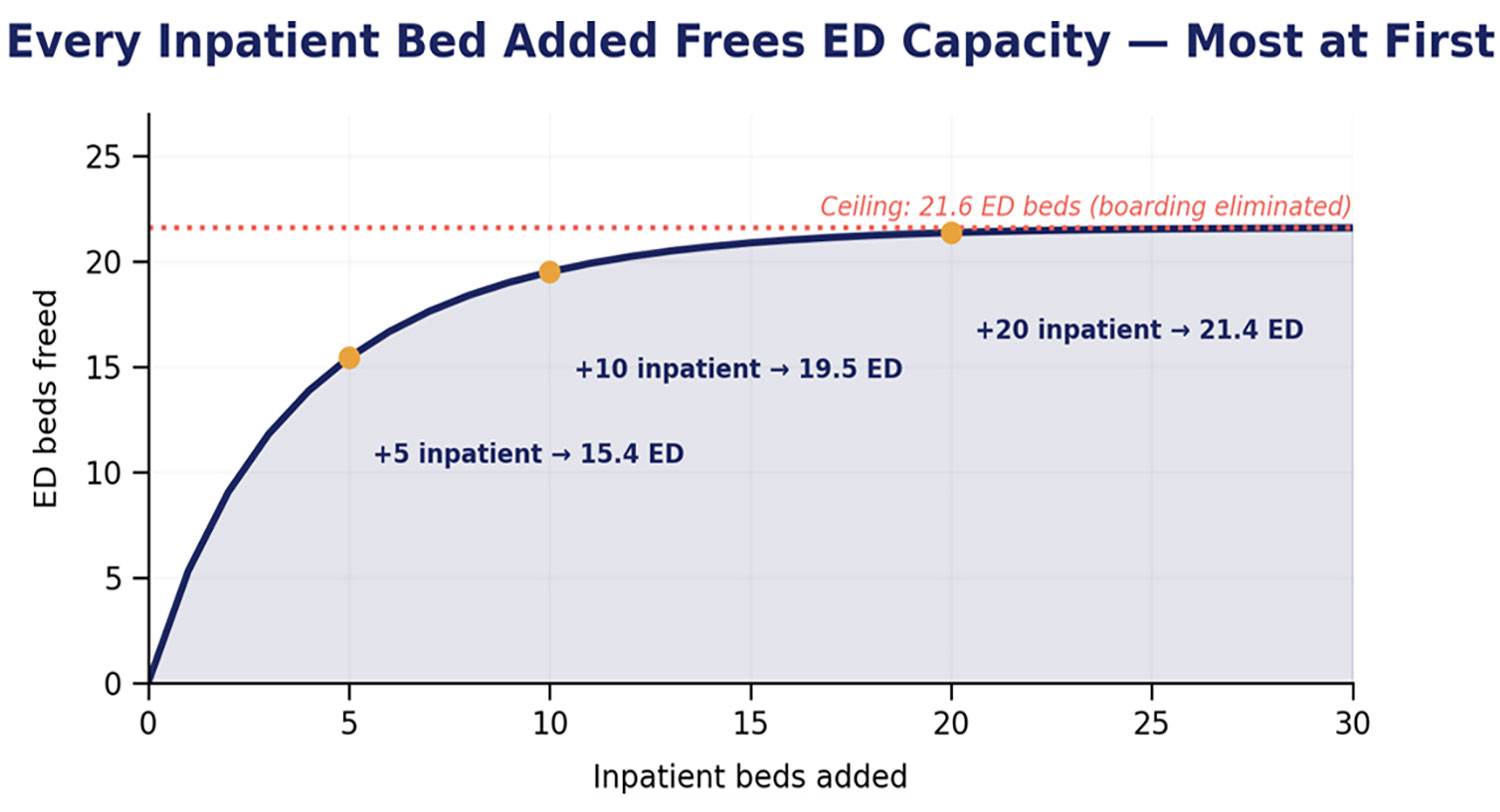
ED beds freed as inpatient beds are added for adult ED admissions. Gains are steep at first, then level off as boarding is eliminated. Adding about seven inpatient beds frees roughly 17 ED beds, enough to offset all 17 hallway beds and leave the 71 treatment rooms to handle the clinical workload.
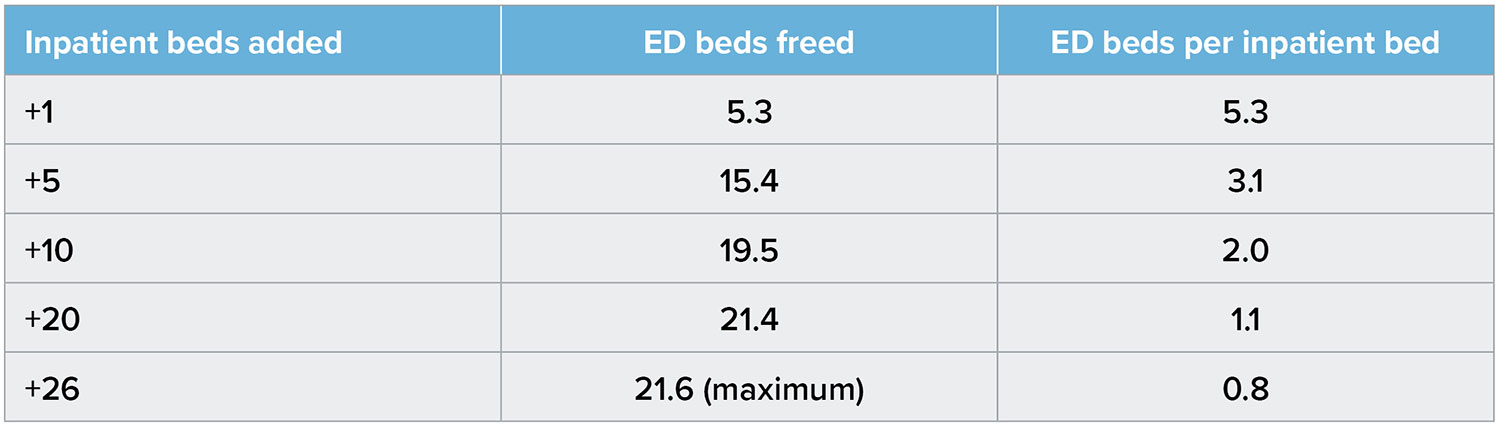
- The first five inpatient beds free about 15 ED beds — about three ED beds for every inpatient bed.
- With 10 inpatient beds, about 19.5 ED beds are freed, representing roughly 90% of the capacity consumed by boarding.
- Beyond about 20 beds, returns level off because no amount of inpatient capacity can free more ED space than boarding consumes.
We recommend adding five to 10 inpatient beds, primarily medical-surgical beds. Freeing 15 to 20 ED beds increases the usable adult ED pool from the 70-to-80-bed range to above the point where diversion begins. It also reduces reliance on the 17 hallway beds, without adding a single ED room. In terms of length of stay, reducing admission boarding to four hours cuts the average adult ED stay from about 524 minutes to about 366 minutes — a 30% reduction, with no change in treatment time.
Pairing capacity with flow
New beds are the structural fix, and the speed at which patients move into any bed matters just as much. Our model shows that shorter boarding times produce the same gains, whether they result from added beds or improved patient flow. Our recommended plan pairs the two:
- Request inpatient beds earlier, ideally when admission becomes likely rather than after the final decision.
- Discharge patients earlier in the day so inpatient beds open before the ED’s afternoon and evening peak.
- Turn rooms faster by matching environmental services staffing to midday discharge volume.
- Protect usable ED capacity by moving behavioral health holds and other long stays out of treatment rooms when possible.
The takeaway
This facility’s adult ED doesn’t need more rooms for emergency care. It needs its rooms back. Nearly half of its bed-hours go to admitted patients waiting for space upstairs — the equivalent of a full inpatient unit. Adding five to 10 inpatient beds, paired with faster patient flow, is the most direct way to return that capacity to the ED and keep ambulances coming to its door.